How Business Idea Score Works
Most business ideas are evaluated poorly.
They are judged based on:
- how exciting they sound
- how big the market appears
- or how many people are talking about them
This approach leads to bad decisions.
Opportunity Scanner uses a different system.
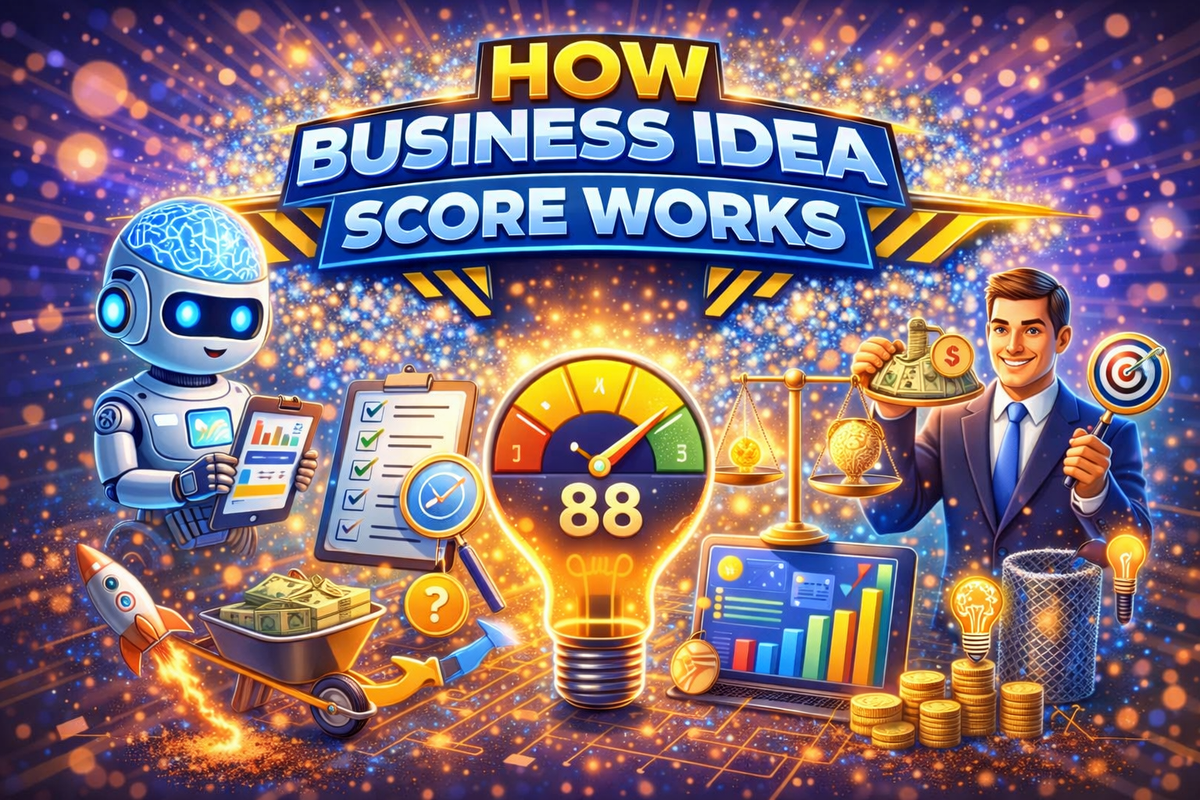
Every idea is evaluated using a structured framework called:
Business Idea Score
This is not a “feeling-based” rating.
It is a multi-factor evaluation system designed to answer one question:
Is this a strong opportunity compared to other ways of making money?
🧠 Core Principle
Before breaking down the score, one rule matters most:
A business can be profitable and still be a weak opportunity.
Why?
Because:
- it may require too much effort
- it may scale poorly
- it may be easy to copy
- it may offer low return relative to time invested
This framework exists to filter exactly that.
⚖️ Scores Are Relative, Not Absolute
Business Idea Score is always relative.
That means:
- a local service business is compared to SaaS
- a side hustle is compared to scalable digital products
- a labor-heavy model is compared to leveraged systems
So when a business scores low, it does NOT mean:
“This business doesn’t work”
It means:
“There are better opportunities available”
🔍 The 11 Evaluation Factors
Each idea is analyzed across the following dimensions:
1. Market Demand
Question:
Do people already want this?
We evaluate:
- real demand vs theoretical demand
- how painful the problem is
- whether customers are already paying
- frequency of the need
High score:
- clear, proven demand
- customers actively paying
Low score:
- weak interest
- unclear problem
- demand based on assumptions
2. Competition Attractiveness
Question:
Is this market still worth entering?
We evaluate:
- number of competitors
- strength of existing players
- price pressure
- ease of customer acquisition
High score:
- fragmented or underserved market
- weak competitors
Low score:
- saturated space
- heavy price competition
- strong incumbents
3. Startup Simplicity
Question:
How hard is it to start?
We evaluate:
- capital requirements
- setup complexity
- tools and infrastructure needed
- regulatory friction
High score:
- low cost
- fast to launch
- minimal complexity
Low score:
- high upfront cost
- operational setup required
- licensing, logistics, or team needed
4. Revenue Potential
Question:
How much money can this realistically make?
We evaluate:
- pricing power
- margins
- customer lifetime value
- volume potential
High score:
- strong margins
- high-value customers
- scalable revenue
Low score:
- low margins
- price-sensitive customers
- limited upside
5. Scalability
Question:
Does revenue grow with effort or with systems?
We evaluate:
- whether growth requires more labor
- ability to automate or systemize
- potential for expansion without proportional cost
High score:
- scalable with systems, software, or distribution
Low score:
- time-for-money
- each new dollar requires more work
6. AI Leverage
Question:
Can technology significantly improve this business?
We evaluate:
- ability to automate tasks
- reduce labor
- improve margins
- enhance output
High score:
- strong automation potential
- AI directly improves economics
Low score:
- mostly physical or manual work
- limited impact from technology
7. Execution Fit (Solo Founder)
Question:
Can one person realistically run this?
We evaluate:
- operational complexity
- need for team
- coordination requirements
High score:
- manageable by one person
- simple operations
Low score:
- requires team from day one
- complex logistics
8. Timing
Question:
Is this the right moment?
We evaluate:
- market maturity
- trends
- adoption curves
- macro conditions
High score:
- early or well-timed opportunity
Low score:
- declining market
- already overcrowded
9. Risk Level
Question:
What can go wrong?
We evaluate:
- operational risk
- financial exposure
- dependency on external factors
- volatility
High score:
- low downside
- manageable risks
Low score:
- high uncertainty
- fragile model
10. Return on Effort
Question:
Is the reward worth the work?
We evaluate:
- time required
- physical or mental intensity
- ongoing involvement
High score:
- strong output for relatively low effort
Low score:
- heavy workload
- constant involvement required
11. Defensibility
Question:
How easy is it to copy?
We evaluate:
- barriers to entry
- differentiation
- brand strength
- unique advantages
High score:
- difficult to replicate
- strong positioning
Low score:
- commodity service
- easily replaceable
🧮 Final Score
Each category is scored from 1 to 10.
Then a final average score is calculated.
Important:
- lower risk → higher score
- lower effort → higher return score
- stronger moat → higher defensibility score
🧾 Verdict System
Every idea ends with one of three conclusions:
BUILD - green
Strong opportunity worth pursuing now.
WATCH - yellow
Promising, but requires validation or better execution.
AVOID - red
Weak opportunity relative to alternatives.
⚠️ How to Read the Score Correctly
A low score does NOT mean:
- the business cannot make money
- no one should ever do it
It means:
there are more efficient, scalable, or attractive opportunities available
A high score means:
- better leverage
- better economics
- better long-term potential
🧠 Final Principle
Most businesses can work.
Very few are worth your time.
Business Idea Score exists to make that difference visible.